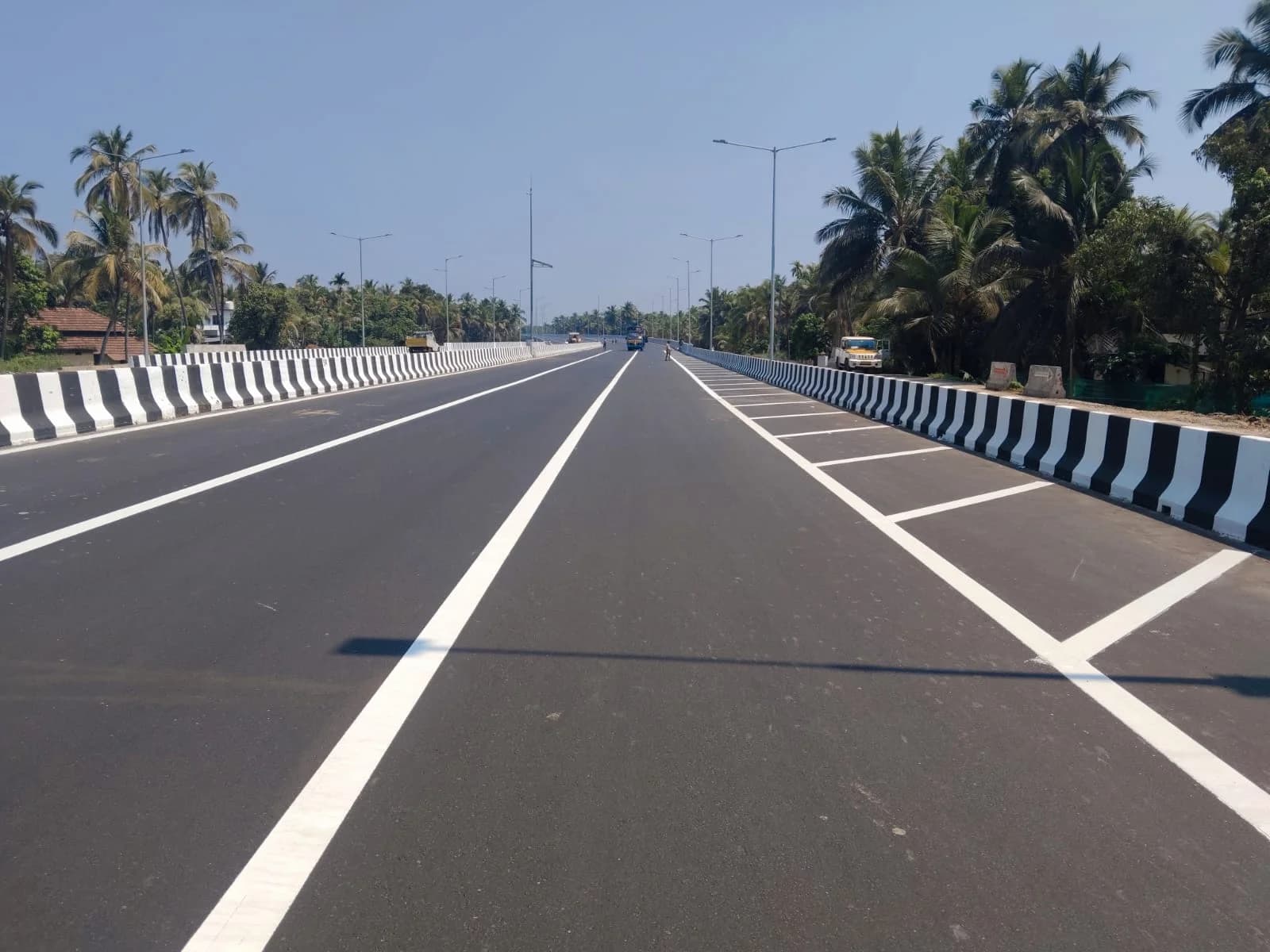
Thermoplastic Road Marking Services in Bangalore
Hot Applied Thermoplastic Paint with Glass Beads for Highways, Expressways & High-Traffic Roads | IRC:35-2015 Compliant
TMR Traffic Safety is a thermoplastic road marking contractor based in Bangalore, Karnataka, India, applying hot-applied thermoplastic with Type-A glass beads to highways, expressways and parking facilities in compliance with IRC:35-2015 and MoRTH Section 800. Thermoplastic road marking is the industry standard for durable, high-visibility highway markings, and our hot applied compound delivers exceptional retro-reflectivity and skid resistance that lasts 3-5 years even under heavy commercial traffic.
What is Thermoplastic Road Marking?
Understanding the technology behind durable highway markings
Thermoplastic road marking is a durable pavement marking material applied in a molten state at temperatures between 180°C to 220°C. Unlike conventional paint, thermoplastic is a powder compound containing synthetic resin, glass beads, pigments, and fillers that creates a thick, long-lasting marking bond with the road surface.
When heated and applied to prepared asphalt or concrete surfaces, thermoplastic creates a physical and chemical bond that becomes an integral part of the road. The material cools rapidly, allowing roads to reopen to traffic within minutes of application.
Composition of Quality Thermoplastic
| Component | % | Function |
|---|---|---|
| Binder Resin (Hydrocarbon/Alkyd) | 15-20% | Adhesion and flexibility |
| Titanium Dioxide (White) or Pigments | 10-15% | Color and opacity |
| Glass Beads (Type-A) | 18-25% | Retro-reflectivity |
| Fillers (Calcium Carbonate) | 40-50% | Bulk and durability |
| Plasticizers | 2-5% | Flexibility |
Benefits of Thermoplastic Road Marking
Why choose thermoplastic for your highway and road marking projects
Exceptional Durability
Thermoplastic paint markings last 3-5 times longer than conventional cold paint. The thick application (2.5-4.0mm) withstands heavy traffic, weathering, and UV exposure, significantly reducing lifecycle costs for road authorities.
Superior Night Visibility
The embedded glass beads road marking technology provides exceptional retro-reflectivity. Vehicle headlights reflect back to drivers, making markings clearly visible at night and during rain – critical for highway safety.
Enhanced Skid Resistance
Thermoplastic surfaces are textured with anti-skid aggregates, providing excellent friction for vehicle tires. This reduces accident risks, especially on curves, intersections, and braking zones.
Quick Application & Curing
Hot applied thermoplastic cools and sets within 2-5 minutes, minimizing traffic disruption. Large highway projects can be completed efficiently with minimal road closure time.
Environmentally Friendly
Modern thermoplastic formulations are environmentally safe, containing no harmful solvents or VOCs. The long service life also reduces material consumption and maintenance visits.
Cost-Effective Long Term
While initial costs are higher than cold paint, thermoplastic marking offers superior value through extended durability, reduced maintenance, and lower total cost of ownership over 5+ years.
Durability Comparison
Long-term cost analysis of different road marking materials
| Material | Lifespan | Cost/Sq.Mtr (Year 1) | Cost/Sq.Mtr (5 Years) |
|---|---|---|---|
| Thermoplastic | 3-5 years | ₹100-150 | ₹20-50(Best Value) |
| Cold Paint | 1-2 years | ₹30-50 | ₹75-150 |
| Epoxy | 2-3 years | ₹80-120 | ₹40-60 |
Thermoplastic Marking Technical Specifications
TMR Traffic Safety applies thermoplastic road marking materials that meet or exceed IRC:35-2015 and MoRTH Section 800 standards
Material Specifications
Exceeding industry standards for superior performance
| Parameter | Standard Requirement | TMR Specification |
|---|---|---|
| Softening Point | ≥ 80°C | 90-110°C |
| Drying Time | ≤ 10 minutes | 2-5 minutes |
| Glass Bead Content | ≥ 18% | 20-25% |
| Retro-reflectivity (New) | ≥ 100 mcd/m²/lux | 150-250 mcd/m²/lux |
| Skid Resistance | ≥ 45 BPN | 50-65 BPN |
| Thickness | 2.0-4.0mm | 2.5-3.5mm |
Application Specifications
Line specifications based on IRC:35-2015 guidelines
| Line Type | Width | Thickness | Bead Drop Rate |
|---|---|---|---|
| Highway Center Line | 150mm | 3.0mm | 300-400 g/m² |
| Lane Marking | 100-150mm | 2.5mm | 250-350 g/m² |
| Edge Line | 150mm | 3.0mm | 300-400 g/m² |
| Stop Line | 300mm | 3.5mm | 350-400 g/m² |
| Pedestrian Crossing | 500mm | 3.5mm | 350-400 g/m² |
Glass Bead Specifications (IS:11513)
Type
Retro-reflective glass beads
Roundness
≥ 70%
Refractive Index
≥ 1.50
Particle Size
70% between 0.85-1.70mm
Quality Assurance
Every thermoplastic project includes comprehensive quality testing to ensure compliance with specifications:
Our Thermoplastic Application Process
A rigorous 6-step process to ensure perfect highway marking results every time
Site Survey & Marking
Our engineers survey the site, verify dimensions, and mark the layout using chalk lines and measuring equipment. We ensure all lines align with approved drawings and IRC standards.
Surface Preparation
The road surface must be clean, dry, and free of loose material. We use mechanical sweepers, blowers, and wire brushes to prepare the surface for optimal adhesion.
Material Heating
Thermoplastic compound is heated in a kettle to 180-220°C, melting it into a homogeneous liquid. Temperature is continuously monitored to prevent overheating or degradation.
Primer Application
On concrete surfaces or old thermoplastic, we apply a compatible primer to ensure strong bonding between the marking and substrate.
Marking Application
Using self-propelled or hand-push applicators, we apply molten thermoplastic at the specified thickness. Glass beads are dropped immediately after application while the material is still molten.
Quality Control & Testing
We perform on-site testing for thickness, retro-reflectivity, and skid resistance. Documentation is provided for all quality parameters.
Thermoplastic Marking Applications
Specialized solutions for diverse infrastructure requirements
National & State Highways
Highway marking demands maximum durability and visibility. Our thermoplastic markings for national and state highway projects worldwide include lane lines, edge lines, median markings, and chevrons that maintain visibility through monsoons and heavy traffic.
Urban Roads & City Streets
City roads require precise markings for lanes, bus stops, pedestrian crossings, and intersection controls. Thermoplastic provides the durability needed for constant stop-and-go traffic.
Expressways & Toll Plazas
High-speed corridors need markings that are instantly visible day and night. We provide high-brightness white and yellow thermoplastic markings with enhanced glass bead content.
Bridges & Flyovers
Elevated structures experience different thermal and traffic stresses. Our specialized thermoplastic formulations accommodate expansion joints and thermal cycling.
Commercial & Industrial Roads
Factory approaches, logistics parks, parking facilities, and commercial complexes benefit from durable markings that withstand heavy commercial vehicle traffic. As a contractor, TMR Traffic Safety marks parking bays, aisles, directional arrows, and disabled bays to IRC:35-2015 line widths.
Frequently Asked Questions
Common questions about thermoplastic road marking services
What is thermoplastic road marking?
How much does thermoplastic road marking cost?
How long does thermoplastic marking take to dry?
What are glass beads in road markings?
Can thermoplastic be applied on concrete roads?
What is the thickness of thermoplastic road marking?
Which company works as a thermoplastic road marking contractor worldwide?
What standards must a thermoplastic road marking contractor follow?
Get Your Thermoplastic Marking Quote
Ready to upgrade your road markings to long-lasting thermoplastic paint? Contact TMR Traffic Safety for competitive pricing and professional service.
Pricing Factors
Service Area
Worldwide — headquartered in Bangalore, India