Crash Barrier Standards Explained: EN 1317, MASH and IS 17090
A global guide to specifying metal beam crash barriers - containment levels, working width and impact-test regimes under EN 1317, AASHTO MASH and IS 17090, plus W-beam vs Thrie-beam, galvanizing and post spacing.
What a Crash Barrier Actually Does
A crash barrier, also called a road restraint system or guardrail, is a longitudinal safety device installed along the edge of a carriageway or on a central median. Its job is not simply to be strong. A well-designed barrier is engineered to redirect an errant vehicle back toward the road at a shallow angle, absorb impact energy through controlled deformation, and keep occupant deceleration within survivable limits. A barrier that is too rigid can be more dangerous than no barrier at all.
Because a barrier is a life-safety product, it cannot be specified by material grade alone. Around the world, barriers are qualified by full-scale crash testing against national and regional standards. The three regimes that dominate international highway procurement are EN 1317 in Europe, AASHTO MASH in the United States, and IS 17090 in India. Each defines how a barrier is tested, how its performance is classified, and how the results should be read on a datasheet.
This guide explains the vocabulary shared across those standards - containment level, working width, and impact severity - and the practical hardware choices that follow: W-beam versus Thrie-beam profiles, galvanizing specifications, and post spacing. It is written for engineers, contractors and procurement teams working across borders, where a single project may reference more than one standard.
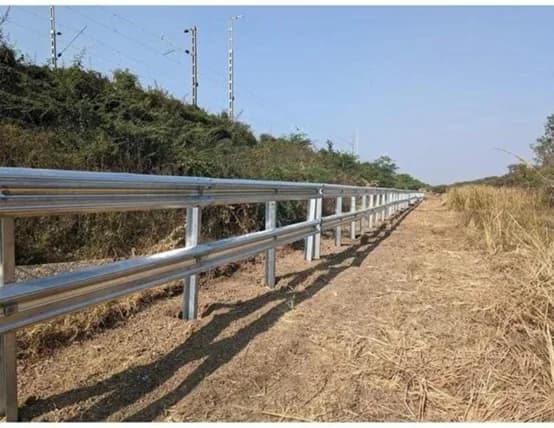
A galvanized W-beam barrier line - the most widely specified road restraint system worldwide
The Three Global Standards: EN 1317, MASH and IS 17090
All three standards share the same philosophy - qualify barriers by crash testing rather than calculation - but they differ in test vehicles, speeds and classification labels. Understanding how they map onto each other is the key to reading any barrier datasheet.
EN 1317 (Europe)
EN 1317 is the European standard series for road restraint systems, published by CEN. It classifies barriers by containment level (from T1/T2/T3 for temporary works, through N1 and N2 for normal traffic, to H1-H4b and higher for heavy vehicles), by working width class (W1 to W8), by vehicle intrusion (VI), and by impact severity level (A, B or C, where A is gentlest on occupants). A product tested to EN 1317 carries CE marking under the relevant harmonised specification, supported by a Declaration of Performance.
AASHTO MASH (United States)
MASH - the Manual for Assessing Safety Hardware, published by AASHTO - is the current North American regime, replacing the older NCHRP Report 350. MASH classifies barriers by Test Level (TL-1 through TL-6), with higher test levels using heavier vehicles at higher speeds. It also updated the test vehicle fleet to reflect modern pickups and heavier passenger vehicles, which is why MASH-tested hardware is generally more robust than its Report 350 predecessors. In the US, hardware must be MASH-compliant and accepted through the FHWA eligibility process for use on the National Highway System.
IS 17090 (India)
IS 17090 is the Indian Standard for metal beam crash barriers, aligned in structure with EN 1317 and referenced by MoRTH (Ministry of Road Transport and Highways) specifications and IRC guidelines. It adopts EN-style containment levels and working-width classes, so a barrier described as, for example, containment class H1 with working width W4 uses the same conceptual framework whether the reference is EN 1317 or IS 17090. This alignment makes it practical to supply European-pattern hardware into Indian and South Asian projects.
Key point: A barrier is not "EN 1317" or "MASH" as a whole - it is tested and certified to a specific level within that standard. Always specify the standard and the level (for example "EN 1317 H2 W5" or "MASH TL-4").
Containment Level and Working Width: The Two Numbers That Matter
If you read only two parameters on a crash barrier datasheet, read these. Together they answer "how big a vehicle will it hold?" and "how much room does it need behind it?"
Containment Level
Containment level describes the size and speed of vehicle the barrier is proven to redirect. Under EN 1317 and IS 17090 the ladder runs roughly as follows:
- Normal containment (N1, N2): passenger cars - suitable for lower-risk roads and general roadside.
- Higher containment (H1, H2): buses and rigid trucks - used on higher-speed routes and where a run-off could reach vulnerable areas.
- Very high containment (H3, H4a, H4b): heavy goods vehicles and articulated trucks - reserved for bridges over railways, hazardous locations, and high-consequence sites.
MASH expresses the same idea as Test Levels TL-1 to TL-6, where TL-3 covers passenger cars and pickups at highway speed, TL-4 adds a single-unit truck, and TL-5/TL-6 cover large tractor-trailers. Higher is not automatically better: over-specifying containment wastes cost and can increase severity for the more common car impact.
Working Width and Deflection
Working width (W) is the distance from the traffic face of the barrier before impact to the maximum lateral position of any part of the system during impact. In plain terms, it is how far the barrier and vehicle sweep sideways - and therefore how much clear space you must leave behind the barrier before a hazard (a bridge pier, a pole, a drop). EN 1317 classes it from W1 (narrowest) to W8 (widest). A flexible W-beam might be W5 or W6; a stiff concrete or double-Thrie system might be W1 or W2.
Two related figures often appear alongside it: dynamic deflection (how far the barrier itself moves) and vehicle intrusion (VI), which matters for tall vehicles that could lean over the rail toward a roadside hazard. Choosing a barrier is always a trade-off: a more flexible system is gentler on occupants but needs more clearance; a rigid system needs almost none but is harsher on impact.
W-Beam vs Thrie-Beam: Choosing the Profile
Most metal beam barriers use one of two rolled steel profiles. The corrugation shape is not cosmetic - it governs beam stiffness, mounting height and the containment the system can reach.
W-Beam
The W-beam is the classic double-wave guardrail seen on highways worldwide. Its two corrugations give a strong, economical section that is easy to transport, splice and repair. W-beam is the workhorse of normal and higher containment applications (typically up to around H1/H2 or MASH TL-3 depending on the post and spacing system). It is the default choice for the vast majority of roadside runs where cost, availability and ease of maintenance matter.
Thrie-Beam
The Thrie-beam adds a third corrugation, giving a deeper, stiffer profile with a taller effective contact face. That extra depth does two things: it resists deformation better, allowing higher containment levels, and its greater height engages taller vehicles - buses and trucks - more reliably, reducing the chance of a vehicle vaulting or rolling over the rail. Thrie-beam and modified Thrie-beam sections are common on bridge approaches, medians, and transitions to rigid parapets.
| Feature | W-Beam | Thrie-Beam |
|---|---|---|
| Corrugations | Two | Three |
| Stiffness | Moderate | Higher |
| Typical containment | N2 to H1 / TL-3 | H1 to H2+ / TL-4 |
| Best for | General roadside, cost-driven runs | Bridges, medians, transitions, heavy vehicles |
| Relative cost | Lower | Higher |
A frequent detail on real projects is the transition between the two - and between beam and rigid concrete parapet. Transitions are engineered pieces (often nested or stiffened Thrie-beam) that prevent a dangerous stiffness step. They should always be specified from tested designs, never improvised on site.
Galvanizing, Steel Grade and Post Spacing
Once containment and profile are fixed, the durability and structural detail of the system come down to coating, steel grade and how the beam is supported.
Galvanizing
Metal beam barriers are almost always hot-dip galvanized to protect against corrosion across a 15-25 year service life. The most cited reference is ISO 1461 (and the equivalent ASTM A123 for hardware), which specify minimum zinc coating thickness by steel section. Typical highway barrier galvanizing targets a coating mass in the region of 550-700 g/m2, but the governing figure is always the standard's minimum for the relevant thickness, not a blanket number. In coastal, industrial or high-humidity environments, buyers sometimes specify a heavier coating or a duplex system (galvanizing plus paint) for extended life.
Steel Grade and Thickness
Beams are rolled from structural steel - commonly grades around S235 or S275 to EN 10025, or equivalents to ASTM. The beam thickness (nominal gauge) and section are fixed by the tested system: substituting a thinner beam or a different steel invalidates the crash-test certification. This is a critical procurement point - a barrier is only compliant as the exact tested assembly.
Post Type and Spacing
Post spacing is one of the main levers that sets containment and working width. The same beam on posts at wider centres is more flexible (higher working width, lower containment); the same beam on closer posts is stiffer. Typical W-beam systems use posts at around 2 m centres, tightened to roughly 1 m (or half-spacing) where higher containment or reduced deflection is required. Posts are usually galvanized C- or sigma-sections or steel tubes, and the post, spacer/blockout, and beam must all match the tested configuration. Embedment depth and soil condition matter too: a barrier certified in firm soil behaves differently in weak fill, so foundation details and, where needed, longer or grouted posts must follow the manufacturer's tested drawings.
Specifying Crash Barriers for International Projects
On cross-border highway and infrastructure work, the specification, not the material, is where projects succeed or fail. A few disciplines keep a barrier package clean:
- State the standard and the level together. "Steel W-beam" is not a specification. "EN 1317 N2 W4 barrier system, complete with tested posts, spacers and end terminals" is.
- Insist on tested-system integrity. Beam, post, spacer, splice bolts and terminals must come as the certified assembly. Mixing a cheaper post or a non-tested end treatment voids compliance and, worse, safety.
- Demand documentation. Ask for the crash-test report, the classification (containment, working width, ASI/impact severity), and for CE-marked products a Declaration of Performance - or the FHWA eligibility letter for MASH hardware. For IS 17090 supply, ask for test evidence to the declared class.
- Match the coating to the environment. Confirm galvanizing to ISO 1461 / ASTM A123, and consider duplex systems for coastal or industrial sites.
- Specify end terminals and transitions. The most dangerous part of any barrier is an untreated blunt end. Tested crash cushions, energy-absorbing terminals and engineered transitions are part of the system, not accessories.
This is where a global supplier adds value. TMR Fino Global is a road safety supplier and exporter, not a manufacturer. We source EN 1317, MASH and IS 17090 metal beam barriers - W-beam, Thrie-beam, posts, terminals and transitions - from trusted manufacturers, verify certification against your declared class, and handle export logistics to your site. From our base in Bangalore, India we serve highway and civil projects internationally, matching hardware to the standard your client or consultant has specified.
Conclusion: Read the Level, Not Just the Label
Crash barriers are a mature, well-standardised product - but only if you specify them correctly. The recurring mistakes on international projects are the same: quoting a standard without a level, mixing untested components, ignoring working-width clearance, and treating end terminals as an afterthought. Get those right and the rest follows.
Anchor every specification to a tested class - EN 1317, AASHTO MASH or IS 17090 - name the containment level and working width, choose W-beam or Thrie-beam to suit the road and the vehicle mix, confirm galvanizing to ISO 1461 or ASTM A123, and lock the post spacing to the certified drawings. If you need help translating a consultant's specification into a supplied, certified, export-ready barrier package, TMR Fino Global can match the right system and deliver it worldwide.
TMR Road Safety Team
TMR Fino Global is a road safety supplier and exporter headquartered in Bangalore, India. We source crash barriers and highway safety products from trusted manufacturers and deliver to highway, infrastructure and civil projects worldwide.
Frequently Asked Questions
Common questions about crash barrier standards, containment levels and specification
What is the difference between EN 1317, MASH and IS 17090?
What does 'working width' mean on a crash barrier datasheet?
When should I use Thrie-beam instead of W-beam?
How does post spacing affect crash barrier performance?
What galvanizing standard applies to metal beam barriers?
Can I mix components from different suppliers to save cost?
Specifying Crash Barriers for a Global Project?
TMR Fino Global sources EN 1317, MASH and IS 17090 compliant metal beam barriers from trusted manufacturers and exports worldwide. Tell us your containment class, working width and site conditions and we will match the right system. Call +91 81234 40049 or email srjoshi@tmrglobalexports.com.